Showing posts with label hackrf. Show all posts

Monday, September 01, 2014

Learning SDR

I recently launched Software Defined Radio with HackRF, an instructional video series that I hope will make it easier than ever for people to learn the basics of Software Defined Radio (SDR).

When I first learned to use SDR for my wireless security research, it was hard. At first I thought, "I can build radios out of software! I don't know anything about building radios, but I know software. Now with SDR I can build radios!" Unfortunately that wasn't quite true. I quickly learned that, even though I knew a thing or two about software, I knew nothing about Digital Signal Processing (DSP). I also learned that DSP is a lot more complicated than it seemed at first.

Fortunately I happened to be in the best possible place to learn SDR (electronics too) at the time. I was surrounded by RF engineers, and several of them were DSP experts. (I told this story in more detail during a panel discussion at the DEF CON 22 Wireless Village.) Even so, it took me a year or two before I was competent enough to build flexible SDR implementations that were useful for my research. As I finally achieved this goal, I started trying to help other people in the information security community learn to use the technology because I could see that there is no better tool for wireless security research, and especially for reverse engineering of radio signals, than SDR.

The first place I tried to do this was at Black Hat USA 2008. In my talk, Software Radio and the Future of Wireless Security I hoped to teach people the basics of SDR in less than an hour. I thought I could do something like "DSP in five minutes", but, as I developed the presentation, it turned out that I couldn't distill the essentials into such a small amount of time. The following year, Dominic Spill and I volunteered to give a two day SDR workshop at the first ToorCamp. We prepared some material, borrowed a little gear, and set out to teach people the practical skills of working with SDR. This effort was much better, but we had some problems. We only had enough equipment for three to six people, and about thirty showed up. We were in a hot desert full of volcanic ash that invaded all our gear. We had frequent power outages. Despite these challenges, we had a good time, and several people were able to learn some essential skills.

A few weeks later at DEF CON, Sergey Bratus convinced me to make a second attempt at the class in a more favorable setting. We happened to have the conversation while standing next to H1kari who offered a room at ToorCon San Diego, and I've been teaching there every year since then. I think we had five or six people that first year. It went quite well, but it was a challenge getting enough hardware together to allow everyone to fully participate. As the years went by, it became clear that the greatest barrier to entry was the hardware. My classes grew slowly, but they were attended primarily by people who already had SDR equipment. I was accomplishing my goal of teaching security folks about SDR, but I wasn't reaching very many people.

I had been kicking around the idea of trying to build a low cost SDR hardware platform for a long time. In fact, Project Ubertooth was originally intended to be an SDR platform. One of the primary reasons I was interested in building an SDR platform was to be able to provide something that my students could afford, something that could even be rolled into the cost of the class. It took a long time, but I eventually started the HackRF project and later completed HackRF One, an open source hardware platform for SDR. HackRF One is the most affordable general-purpose SDR transceiver in the world, and it allows more people than ever before to learn SDR.

These days I still teach at ToorCon, and I also often teach at other information security events including TROOPERS and Black Hat. The availability of HackRF (and rtl-sdr and more) has made SDR accessible to everyone in the security community and beyond. It is finally possible to bring SDR to a much wider audience, so I have started turning my course content into an online video series.

Software Defined Radio with HackRF is published under an open content license. As I continue to add more videos, I hope that it will become an even more thorough introduction to SDR than I am able to squeeze into a two day class. I hope that with this series and my in-person training, I have finally achieved my dream of making SDR easy to learn. Instead of taking a year, now people can spend a few days of fun experimentation and get started with this exciting technology.

Tuesday, June 10, 2014

Interview on Security Weekly

I had a great time talking with Paul and company on the Episode 376 of the Security Weekly Podcast. We talked a little about HackRF, but most of the discussion was about Ubertooth and Bluetooth security. This conversation prompted me to write a full description of how we recover Bluetooth UAPs by passive monitoring with Ubertooth.

Friday, January 10, 2014

HackRF Present and Future

At CSAW THREADS in November I gave a talk about the present and future of the HackRF project (video). I reviewed the new HackRF One design, and then I showed all sorts of different things that people are already doing with HackRF Jawbreaker. It's pretty exciting to see all the applications that people are coming up with!

Saturday, October 26, 2013

Appearance on The Amp Hour

In case further evidence is needed to demonstrate that I am a terrible blogger, I submit this: I had a wonderful time as a guest on Episode 161 of The Amp Hour and forgot to mention it here for nearly eight weeks! We discussed HackRF, Daisho, Ubertooth, wireless security, and how I came to the world of open source hardware from a background in information security. Thanks for having me on the show, Chris and Dave!

Wednesday, July 31, 2013

HackRF is on Kickstarter

I launched HackRF on Kickstarter today. I hope you'll take a look, pledge your support, and spread the word. Thanks for your support!

Sunday, June 23, 2013

HackRF LEGO Car

In the Hacker Lounge at Open Source Bridge last week, the well-stocked LEGO table caught my eye. In particular, I spotted an antenna protruding from the pile, and I followed it down to a radio-controlled LEGO car platform! The controller was quickly located, a battery replaced, and I found that it worked pretty well.

The controller was clearly marked with a sticker indicating operation at 27 MHz (FCC ID: NPI71646). That would have been my first guess anyway as it is a very popular frequency for radio-controlled toys. Since several of us were having a HackRF party, I decided to see if I could control the car with my HackRF Jawbreaker.

After verifying that the car worked with the original controller, I recorded several waveforms with the hackrf-transfer utility. I made eight separate recordings, one for each active controller state: forward, backward, left, right, forward/left, forward/right, backward/left, and backward/right.

The recordings were quite clean even though 27 MHz is below Jawbreaker's official operating range (30 MHz to 6000 MHz). In fact, I had captured some apparently good recordings of NFC transactions at 13.56 MHz just the day before. The major drop-off in performance I've observed on Jawbreakers I've tested has been just below 10 MHz.

The first HackRF transmission I tried was by building a small flowgraph in GNU Radio Companion to replay the captured waveforms with my Jawbreaker one at a time. With the car's controller switched off, I was able to make the car move with a simple replay! The best waveform worked at a distance of up to 20 meters even though I put very little effort into cleaning up the waveform or adjusting the power level.

Although I didn't have much time left before I had to catch my flight home, I wanted to see if I could synthesize control transmissions in software on my laptop instead of replaying captured waveforms (that included received noise and minor defects such as quantization and DC offset).

The first step toward synthesizing control transmissions was to analyze the captured waveforms. I found that each transmission consisted of a series of pulses at 27.145 MHz. The pulses were all at the same power level. Each pulse lasted one of two durations and was followed by a pause of consistent length. It looked like On-Off Keying (OOK) with data encoded in the number of consecutive short pulses.

Each transmission featured a repeated pattern of four long pulses (each 1.875 ms long, separated by 0.625 ms pauses) followed by some number of short pulses (each 0.625 ms long, separated by 0.625 ms pauses). The repeated pattern continued for as long as the controller was held in a particular state. The number of consecutive short pulses depended on the state of the controller:

  • forward: 10 short pulses
  • forward/left: 28 short pulses
  • forward/right: 34 short pulses
  • backward: 40 short pulses
  • backward/left: 52 short pulses
  • backward/right: 46 short pulses
  • left: 58 short pulses
  • right: 64 short pulses

That's as far as I got.

Saturday, June 22, 2013

HackRF Beta Distribution

I've been working day and night to test, rework (You don't mind a few scorch marks, do you?), and ship HackRF beta units over the last four weeks. It has been a bigger job than I planned on, but the end is near. I expect to ship the last of the beta units before the end of June. I will have shipped a total of 500 units with more than 200 of those going to people who signed up for the waiting list.

The main reason that it has taken so long is that there has been more testing and rework required than I expected. The test procedure I gave to the contract manufacturer wasn't good enough, mostly because it performed RF tests over the air instead of over a cable with fixed characteristics. Since changing the procedure to operate over an RF cable with an attenuator, I am getting very consistent results. Unfortunately those results aren't always positive, so I've had to do a lot of rework. Plus, I've had to spend a great deal of time running the tests at my kitchen table.

Allergy warning: cats have climbed into boxes full of HackRF Jawbreakers!

I've fallen a bit behind on email while doing all this work, but many of those messages contain frequently asked questions about beta distribution that I will list here:

Q: How many people registered for the beta and how many beta units will ship?

A: I received a total of 2288 registrations. Over 400 units have shipped already. A total of approximately 500 units will ship. About 225 of those will go to people on the waiting list (those who registered without a valid beta invitation code). I wish I could give a board to all 2288 of you, but unfortunately supplies are limited. Still, I am proud to have accomplished such a large give-away of open source hardware.

Q: What are my odds of receiving a Jawbreaker?

A: If you registered with a valid beta invitation code, a beta unit should have been shipped to you already (100%). If you registered without a code, you will receive a Jawbreaker only if you were among the first 11% or so of people who registered. If you heard about beta registration from the GSG-announce mailing list, irc (#hackrf on freenode), or by following me on twitter and acted quickly, you have a good chance of getting a board. If you signed up later without a code, you probably will not get a board.

Q: Will I receive a confirmation email even if I do not get a beta unit?

A: Yes. If you included a valid email address with your registration you will receive an email either way. If a beta unit is shipped to you, I will send you an email that day. As soon as beta supplies are exhausted I will send an email to everyone still on the waiting list letting you know that you will not receive a unit.

Q: How are beta units shipped?

A: I'm shipping all beta units via USPS First-Class Mail or First-Class Package International Service. I realize that this isn't the speediest service for international beta testers and that time in customs can vary greatly, but keeping the cost low is part of how I am able to ship so many total beta units.

Q: What if my Jawbreaker fails?

A: Unfortunately I expect some hardware failures in the field. Even units that passed my improved test procedure might fail in the future. I've already seen (and replaced) one such unit that had a weak solder joint that failed after being shipped to a beta tester. I can't guarantee you a working beta unit, but I will do my best to repair or replace units that fail. If you suspect a hardware failure or have any other technical concerns, post your question or test results to the hackrf-dev mailing list.

Q: When can I buy a HackRF board?

A: I will make an announcement about commercial availability soon. If you want to be among the first to hear about it, sign up for the GSG-announce mailing list.

Thursday, May 09, 2013

Giving Away HackRF

The HackRF project has been open source from the very beginning. Even before we started the project, Jared Boone and I wanted to have an open source hardware platform for Software Defined Radio (SDR). Our early prototype designs were published in our repository along with every step of our hardware and software development, and we used open source development tools including KiCad and GCC.

We felt that the world needed an open source hardware design for SDR. GNU Radio had been around for several years, leading a thriving community of open source software development for SDR, but no general purpose SDR hardware designs were available under an open source license. Both Jared and I had started our own businesses devoted to open source hardware development because we felt strongly that open source is simply the right thing to do, and we thought that an SDR peripheral would be an important contribution we could make to the open source hardware and SDR communities.

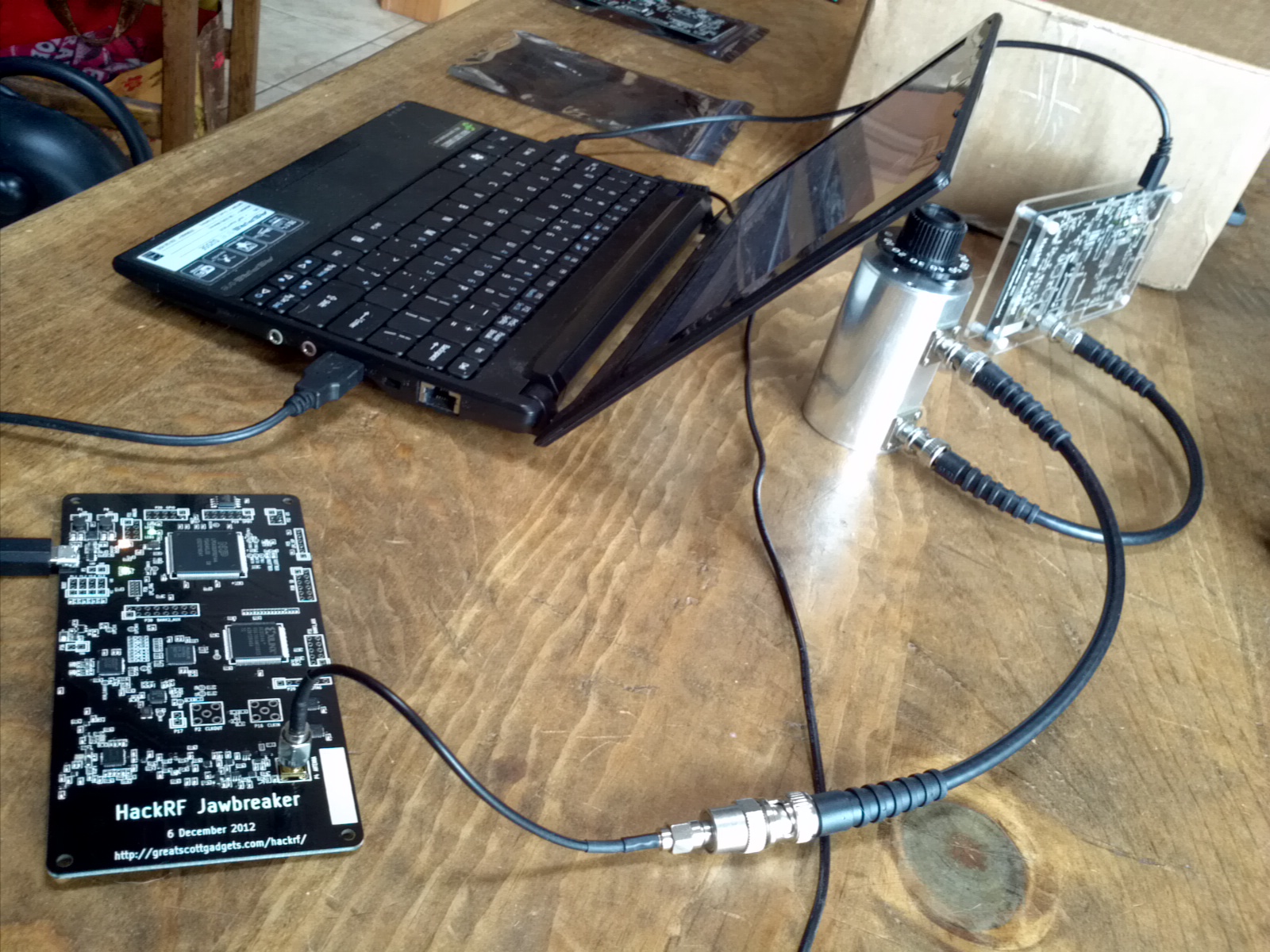
More than a year later, I am sitting in my lab testing the first sample Jawbreakers from the factory while hundreds more are being assembled and tested. Jawbreaker is the HackRF beta design, and I'm getting ready to ship beta units to as many people as possible. It is a USB-powered SDR peripheral that can transmit or receive virtually any radio signal from 30 MHz to 6 GHz, a range of operating frequencies even wider than our original, ambitious goal.

More than 500 Jawbreakers are being produced right now, and I plan to give nearly all of them away. It is incredibly exciting to be giving people actual hardware in addition to giving away the design! As far as I know, this is the largest beta give-away of any open source hardware project to date. We are thankful for the support of the DARPA Cyber Fast Track program that enabled us not only to develop HackRF in the first place but to produce and distribute so many beta units.

If you would like to participate in the beta program and receive your own Jawbreaker, you can register today. It's free! I distributed beta invitation codes to the attendees of ToorCon 14 and the 2012 GNU Radio Conference last fall. Each of those codes may be used now to register for a spot at the top of the beta list. There are more Jawbreakers than codes, so you can also get on the waiting list for additional units even if you do not have a code. I don't know how many codes will be redeemed, but there is a good chance it will be less than 100%. In order to be fair to the people on the waiting list and to avoid having a large pile of unused Jawbreakers, I established a deadline for the use of invitation codes. The deadline (20 May 2013) is approaching rapidly; if you have any friends who were at ToorCon 14 or the 2012 GNU Radio Conference, this would be a good time to remind them to use their codes!

Benjamin Vernoux, one of the HackRF developers, sent me an enclosure he designed for Jawbreaker, and it fits very nicely. It is based on the Sick of Beige case design from our friends at Dangerous Prototypes. I will not be shipping enclosures with the beta units, but you can download the design and either order one for yourself or make one on your own laser cutter. Don't have a laser cutter? Maybe it's time to make some new friends at your local hackerspace!

Monday, April 29, 2013

Register for the HackRF Beta Test

It is now time to register for the HackRF beta test. Invitation codes that I distributed at ToorCon 14 and at the 2012 GNU Radio Conference may be redeemed for a HackRF Jawbreaker by registering for the beta test. If you do not have a code but would like a beta unit, register without a code and you will be placed on a waiting list for excess units.

I expect the beta units to ship by the end of May. Thanks for your patience, everyone!

Wednesday, February 06, 2013

Jawbreaker Components Ready to Ship

The last components needed for the HackRF Jawbreaker beta production are now ready to ship to China for manufacturing. Unfortunately some additional delay caused us to run into Chinese New Year (bane of electronics designers), so the parts will not be shipped until after the extended holiday. This means that assembly will start around the end of February. I should have the finished boards in March.

Meanwhile work continues on the software. We have fixed a few bugs and now are able to operate at 16 million quadrature samples per second (and still hoping for a little more). Currently, thanks to Benjamin Vernoux and helpful denizens of our IRC channel, we are fixing some bugs in libhackrf on Windows. Although our primary development focus is on Linux, we hope to support other popular operating systems too.

The delay has given me time to focus on some other projects as well. It is going to be a fun year!

Thursday, December 06, 2012

HackRF Beta Update

Sorry, folks! HackRF beta manufacturing (that I had hoped would take place in December) has been delayed until late January or early February. The reason for the delay is the most mundane that you can imagine: ordering components and getting them all delivered to the factory.

Generally speaking, it's pretty easy to buy a handful of parts for prototyping, and it is easy to buy tens of thousands for manufacturing. Buying 500 units of a part at a reasonable price for low volume manufacturing isn't always easy, however. A few of the components took several weeks to source, but they are all on order as of this week.

One component was particularly problematic, the Si5351C clock generator IC. We weren't sure why we were having so much trouble locating 500 units of Si5351C-A until the Si5351C-B suddenly appeared on the market. The new revision is only a little different than the old one, but it has some advantages; the biggest advantage is availability! I had a few units overnighted to me and tested them. Unfortunately changing to the new revision required that I add a single resistor to the Jawbreaker design. It's a very minor change, but even small changes have the potential to cause delays. In this case, the long lead time for some of the components has given us enough extra time that we can make such a change as necessary.

The good news is that we were finally able to order everything at pricing close to what I anticipated. Beta units will likely be shipped in February, so look for an announcement around that time.

Thursday, October 25, 2012

Announcing the HackRF Beta

Jared Boone and I had the honor of presenting the keynote at ToorCon 14 over the weekend. In our talk, HackRF: A Low Cost Software Defined Radio Platform, we described our project to build a low cost, open source, wideband, portable Software Defined Radio peripheral. You can watch video of the presentation or download the slides.

In addition to introducing HackRF to the ToorCon audience, we announced the HackRF beta test program. Thanks to DARPA's Cyber Fast Track (CFT) program, we are able to build a few hundred HackRF Jawbreakers and will distribute them to ToorCon attendees as soon as they are completed (hopefully around December). Each attendee of ToorCon 14 (and also the recent GNU Radio Conference) received a unique beta invitation code that can be redeemed for a Jawbreaker as soon as the hardware is ready to ship.

Jared and I are very excited to be able to give away so many beta units. I'm not sure if any open source hardware project has had such a well funded beta program, but we think that giving away hardware in exchange for feedback (and hopefully some code) is a good trade in keeping with open source ideals.

If you have an invitation code, look for an announcement on the HackRF page around December telling you how to redeem your code for a Jawbreaker. I know there are many of you out there who wish you had an invitation code, and I'm sorry that our funding for the beta program is finite! The redemption system, once it is live, will include a way to sign up for a waiting list if you do not have a code. There will probably be some extra beta units that we will distribute to as many on the waiting list as we can.

My hope for the beta program is to validate HackRF Jawbreaker, resulting in a well-tested open source design that anyone can build or modify. I also plan to release a commercial HackRF product (similar to Jawbreaker) that will be available for purchase after the beta.

Thanks for all the kind words of support at ToorCon and since!

Monday, October 01, 2012

HackRF Jawbreaker

Last week at the GNU Radio Conference I showed off Jawbreaker, the first unified HackRF board. I had assembled it just prior to leaving for the conference. It is completely built (including a couple of minor corrections), and I am about three-quarters of the way through validating the design.

Jawbreaker integrates three separate designs into a single circuit board, making it smaller and easier to handle. Since my previous post, I tested multiple wideband front-end designs, eventually settling on one called Licorice. Jawbreaker is a combination of Licorice, Lemondrop, and Jellybean into a single USB-powered software radio transceiver peripheral designed to operate from 30 MHz to 6 GHz.

This week I plan to finish validating the design and ordering PCBs of the next (likely final) revision. While I validate and revise the hardware design, Jared is hard at work on a USB driver for the LPC43xx microcontroller on the board. Prior to combining the three boards into Jawbreaker, I successfully tested both transmit and receive paths from the antenna all the way to the microcontroller, but the "last mile" USB communication from the microcontroller to the host computer was still incomplete.

I had planned to bring a finished Jawbreaker for everyone attending my software radio workshop at ToorCon San Diego later this month, but unfortunately it doesn't look like I'll have enough working units by then. Instead I will provide alternative hardware that will fully enable everyone to participate in the workshop exercises, and I will send Jawbreakers to the attendees when they are finished later. (There are still a couple of seats open in the workshop, by the way.)

A puzzling feature you might have noticed on Jawbreaker is the integration of a PCB trace antenna for the 900 MHz band. Although the board is designed for operation over a much wider frequency range, this antenna allows people to start experimenting with the board in the 900 MHz band immediately without any antennas, connectors, or anything at all other than a USB cable and computer. I want it to be easy for people to get started with the device because Jawbreaker is intended as the beta test platform for the HackRF project. We plan to assemble quite a few Jawbreakers and will distribute them to beta testers in the coming weeks. Beta hardware availability will be announced at ToorCon.

Friday, June 22, 2012

Introducing HackRF

I'd like to take a moment to properly introduce the project that is consuming most of my time this year: HackRF, a software radio peripheral. Software radio or Software Defined Radio (SDR) is the application of Digital Signal Processing (DSP) to radio waveforms. It is analogous to the software-based digital audio techniques that became popular a couple of decades ago. Just like a sound card in a computer digitizes audio waveforms, a software radio peripheral digitizes radio waveforms. It's like a very fast sound card with the speaker and microphone replaced by an antenna. A single software radio platform can be used to implement virtually any wireless technology (Bluetooth, GSM, ZigBee, etc.).

Digital audio capabilities in general purpose computers enabled a revolution in the sound and music industries with advances such as hard disk recording and MP3 file sharing. Today's computers are fast enough to process radio waveforms in similar ways, and the radio communications industry is going through the same sorts of changes. One critical advance has yet to take place, and that is the availability of low cost tools enabling any computer user to take part in the revolution.

HackRF project goals:

  • transmit and receive
  • operating frequency: 100 MHz to 6 GHz
  • maximum sample rate: 20 Msps
  • resolution: 8 bits
  • interface: High Speed USB
  • power supply: USB bus power
  • portable
  • open source hardware and software
  • low cost

There have been some exciting developments in the world of low cost software radio hardware in recent months, but the HackRF project will go much further. A key advance will be the ability to transmit as well as receive radio signals, and HackRF will also enable operation at higher frequencies, including the popular 2.4 GHz band. Most importantly, HackRF is an open source project, so people will always be able to use and modify the hardware design and software in the future. We are being very careful to only use electronic components with published documentation (no NDAs!) and to avoid software libraries without open source licenses. This means more work for us, but we think that it will be worth it in the long run.

Speaking of us, I should mention that I have some help on this project. My primary partner in this effort is Jared Boone of ShareBrained Technology (who has already written a bit about some of our development challenges). We've had some additional help from a few other people who hang out in #hackrf on chat.freenode.net, notably Benjamin Vernoux.

Ultimately, the HackRF project aims to produce a single device that meets the goals above, but right now it consists of multiple development boards that connect together. The microcontroller, USB interface, and power supply are on the largest board called Jellybean. The Intermediate Frequency (IF) transceiver, Analog to Digital Converter (ADC), Digital to Analog Converter (DAC), and clock generator are on a board called Lemondrop. Most recently, a wideband front-end called Lollipop is being tested. HackRF is based on a dual conversion architecture with a high IF (between 2.3 and 2.7 GHz), allowing us to take advantage of the excellent capabilities (per size, cost, and power consumption) of a wireless transceiver IC.

I have used software radio techniques for wireless security research for years, and I teach a workshop each year at ToorCon San Diego to help more people in the information security community become familiar with the technology. Both for my own use and to promote wireless security research, I have long dreamed of building a low cost, portable platform. Now, with support from DARPA's CFT program, I am finally able to make this project a reality.

Personally, I want a single device that can fit in my laptop bag, that doesn't require a bulky power supply, and that I can use to hack on whatever wireless systems I encounter. I'm hoping it will be about the size of a portable USB hard drive, and it will probably end up with a retail price in the neighborhood of $300, higher than technology-specific solutions like Ubertooth One but much less than any software radio transceiver on the market today.

The project is going well, and we are likely to meet most or all of the goals. If there is one we miss, it will probably be the operating frequency range. 100 MHz to 6 GHz is quite ambitious! At the very least, we will produce a platform that allows operation over a wide range including both the 2.4 GHz and 900 MHz bands.

HackRF is being developed on github. Documentation is coming together slowly on the wiki.