Showing posts with label ice. Show all posts

Friday, February 24, 2012

The Icetweets Cometh

On Sunday I will leave for Fairbanks for another year of carving ice with Lars Hansen at the World Ice Art Championships. After taking last year off, we will once again compete in the Single Block Classic next Tuesday through Thursday.

I'm going to do one thing differently this year: Instead of blogging about our progress (and struggling to post up-to-date information), I'm going to try tweeting. I've only been on Twitter for about a year, and this will be my first ice carving event since then. It should be easier for me to post quick updates and photos that way without having to take as much time away from the competition to prepare blog entries.

So, for those of you who have followed our ice sculpting escapades on this blog in the past, you should keep an eye on my Twitter feed this time around. I may post a little bit (like hopefully a web cam link) here, but most of my updates will be over there. My poor Twitter followers (who mostly know me for things unrelated to ice) have no idea what's coming!

Oh, and here's a photo from Lars, a sneak peek at what we'll be doing next week!

Wednesday, February 23, 2011

a year without ice

For the first time in several years, Lars and I are sitting out of the World Ice Art Championships. I'm rather busy with other things this year, and Lars would have had even more difficulty than usual taking time off work. I'm pretty sure we'll be back at it next year, but this time I'm enjoying watching the Single Block Classic web cams from far away in Colorado.

Of course, this winter hasn't been entirely without ice. I haven't picked up a chisel yet, but Lars made a few sculptures (with help from Celso) for his school's winter ball, and both of us have started experimenting with new methods of producing our own ice for carving.

For sculpting, it is almost always desirable to have very clear ice, not white ice, but making a sizable chunk of clear ice is tricky. The problem is that liquid water contains quite a bit of air and often some sediment or other impurities that become more obvious when frozen. As the ice forms, the crystal structure forces the air into pockets that become large enough to see, and all those little bubbles make the ice white. White ice is often unappealing visually, and it is structurally weaker.

The most common technique used to produce commercial carving blocks is to continuously circulate the liquid water as it cools, keeping the top surface in particular from freezing before the rest of the block does. Without this recirculation, ice naturally forms on the top surface first, forming a barrier that prevents air from escaping the rest of the block. Lars had the idea that, instead of recirculating the water, we could keep the top surface from freezing first by simply heating it directly. Here you can see him extracting a large block from the giant "Ice Cube Tray" in his yard. I believe he used a small aquarium heater to do the job, and he was pleased with the result.

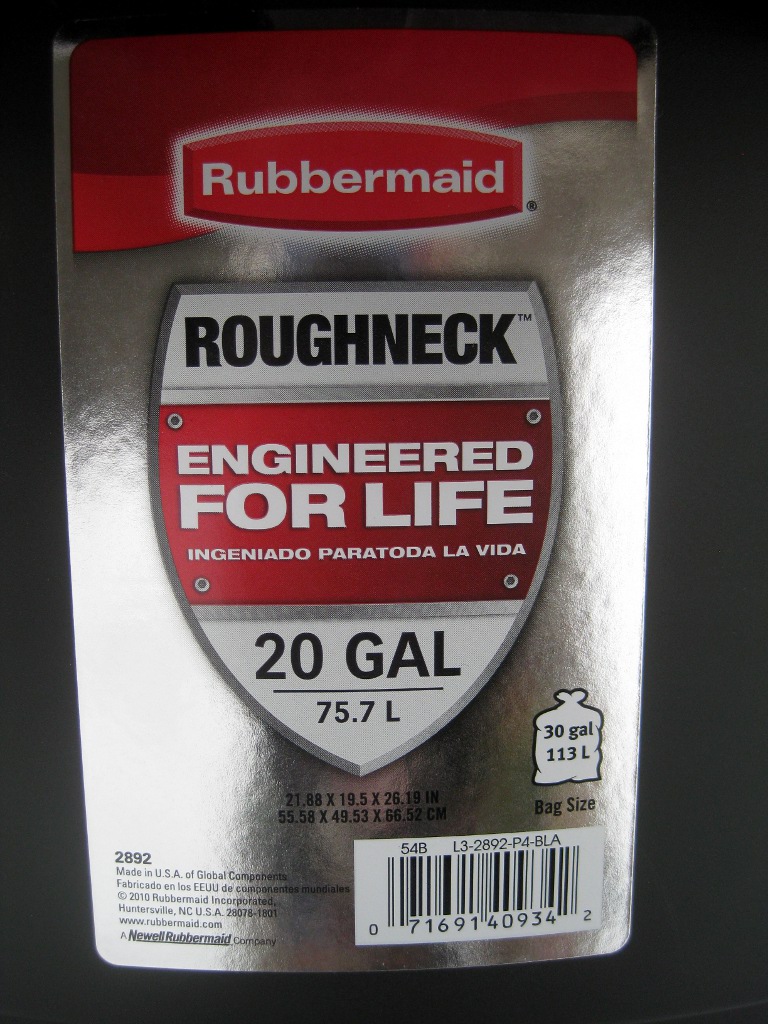
I want to try the same thing in Colorado, but I don't have weather so cold as Lars does in Fairbanks. I am afraid that a simple aquarium heater might produce too much heat, but I will give it a try. I figure the worst case scenario is that I have to build my own temperature control device. Not wanting to handle ice cubes as big as Lars's, I picked up a 20 gallon trash can for my experiment. I didn't even have a simple heater when some particularly cold weather came to town recently, so I just filled the bin 3/4 full of well water and set it outside to freeze. This is so I'll be able to compare subsequent results with heating to the result without heating.

As you can see from the block of ice split in twain, the result was terrible. Not only was the entire block full of tiny air bubbles, but a large air pocket formed in the center. When mostly clear ice has a central region with lots of little bubbles, that region is called the "feather." This is far worse. Interestingly, I didn't even have to split the ice myself. I pulled it out of the trash can on a relatively warm day and only looked at the surface. A day or two of above-freezing temperatures later I found that it had split apart on its own!

Wednesday, March 17, 2010

Quixote's Nightmare

Quixote's Nightmare is an abstract ice sculpture that captures a view through the eyes of Don Quixote. Lars Hansen and I completed it as our entry in the Single Block Classic at the 2010 World Ice Art Championships. The piece was illuminated with white lights for judging the first night.

We returned a couple nights later to see the sculpture under colored lights. I like the colors the Ice Alaska lighting crew picked for us! Sculptors are encouraged to submit lighting design diagrams, but this year we decided to let someone else choose for us.

While we were there, I stupidly tried to brush some snow off of the wheel at the front of the piece. The left eyeball came crashing down! Fortunately this happened 48 hours after judging and after the official photos were taken, and ice sculptures are temporary anyway. I still feel bad, though. Here you can see the eye resting on the ground. It is a nice piece that Lars turned on the lathe. He also sculpted the interior of the eyeball with the boiler.

From the side you can see the linkage mechanism quite clearly. The piece was intended to be a working machine, a windmill whose rotor turns when the wheel on the front is turned, but the mechanism failed to function. last year's piece still stands as our most successful mechanical sculpture. Apart from the mechanical failure, we thought that this year's effort was a great success overall.

Quixote's Nightmare tells a story much more than any of our previous sculptures. We had a lot of fun figuring out how to bring the story to life both artistically and mechanically. I was particularly fond of the inscription we chose.

Sunday, February 28, 2010

daily photos

Ice Alaska finally posted the daily photos of our piece. I hope to have some more up in the next few days.

Saturday, February 27, 2010

our five thousand pound delusion

By mid-afternoon Thursday we had turned our attention toward assembly of the mechanism. The weather was considerably colder than the previous two days. Unfortunately this made the ice more brittle, and we had trouble with fusing. The upper axle (the one that connects to the rotor) broke clean through in two places while Lars bonded it to the cams! Lars had to turn a replacement on the lathe. While he was doing that I worked on adding suckers to the rotor and shaping it, and I broke it! Twice!

We wasted a lot of time repairing or replacing broken parts when we were already short on time, but we were able to get everything back together.

After Lars finished the replacement axle and carved out the remaining bits of the broken one, we were ready for re-assembly. We had it all glued together and ready for a critical step: cutting out the intermediate (between the cams) section of the two main axles in order to provide clearance for the linkage. Lars hesitated and suggested that maybe we should just assemble the sculpture as a static piece and not try to make it work. He thought that the weather conditions and time constraint made it very unlikely that the machine would work correctly, and we both feared that any failure could be catastrophic, destroying several parts at once. I held the opinion that we should try to make it work regardless. Since we disagreed and needed to make a decision quickly, Lars suggested that we flip a coin. At about 8:15 PM (45 minutes remaining) the coin dictated that we would try to make the thing work.

After a little more work preparing various components, Lars sliced through the axles with a saw. The mechanism held together, so we attempted a gentle rotation. Failure! One of the cam/axle joints cracked, and the two halves of the upper axle tipped toward each other by a few degrees. We both instantly came to the conclusion that the mechanism could not be salvaged in time, so we started applying slush to critical points in order to freeze the machine in place. We were lucky that the failure was relatively invisible and not catastrophic, so we froze everything to prevent damage caused by additional movement.

With only a few minutes remaining, we attached the final few components. The front wheel failed near the center (I had removed too much ice from the back side trying to reduce its weight), so we chiseled out the rest of the axle connector and tacked it onto the front face of the sculpture by the the tips of its tentacles as the horn sounded. It stayed!

During the clean-up period I made a sign with the inscription:

"Though ye flourish more arms than the giant Briareus, ye have to reckon with me." - Don Quixote

We were disappointed that the mechanism didn't work but pleased that the sculpture came together as a whole. It was very fortunate that the cam/axle failure did not result in collapse and breakage of the entire linkage assembly. Unfortunately the time we spent making up for various damaged parts meant that we didn't have enough time for much texturing and finishing work. Some of the parts even had snow caked on them. We felt satisfied nonetheless, and I was reminded of something Lars said some years ago when it seemed unlikely that some mechanism would function: "Art may break out at any moment!"

Thursday, February 25, 2010

it's time to let your babies grow up to cowboys

It's time to let the bed bugs bite.

We made good progress this morning. The body has been completely shaped down to the ground. The giant tentacles have 90% of their suckers, and the eyes have been turned on the lathe. Time to get back out there!

Tentacular, Tentacular!

We resolved to sleep well Monday night and have a good breakfast. These goals were achieved.

Tuesday morning we established our battle plan for the day, and it centered around sculpting the main body of the beast. In order to prepare for this, our principal morning activity was to insert pins (grafts? sutures?) across the terrible crack on either side of the body. These were fused in place by lunch. In the afternoon we added buttresses (which ended up being flying buttresses) to provide additional support and contact area across the crack. After dinner we declared the structure sound enough to survive a chainsaw, so we attacked it immediately. By midnight it was almost entirely shaped, and we called it a day. The sculpture appears to be quite sturdy, and we didn't even have to modify the overall shape all that much to make it so.

Throughout the process of reinforcing the cracked body, there was plenty of time to do other things while waiting for bonds to cure. We worked on the wheel (the thing that people turn) and the windmill blades. We also started preparing the three largest tentacles and finished all the machine parts.

We have our work cut out for us tomorrow, but we believe that we can finish the piece by the time the horn sounds at 9:00 PM.

Oh, and yes, that tentacle pictured in my previous post is one of ours. We have not yet resorted to stealing from Junichi.

Wednesday, February 24, 2010

we destroyed a lot of ice today

At some point today they finally published the correct link to our webcam. If you hadn't found it yet, you haven't missed a whole lot. Mostly Lars and I spent the day working on small parts that aren't very visible from a distance, and we were probably off camera quite a bit of the time.

If you have been watching, you may be wondering why our sculpture looks so blocky and boring! While we were carving giant chunks out of the block early in the day, the central tall piece of the sculpture, the primary lobe of the monster's body that supports the windmill blades, suffered a major crack at its base. We were in the process of removing the large block in front of it, and it came loose and wobbled forward and back! We had to spend some time reinforcing the weak area and were avoiding touching that part for the rest of the day in order to give it time to heal. If the crack were to fail completely it would be catastrophic for the entire sculpture. We plan to spend some time tomorrow morning adding additional support.

We did manage to continue extracting some ice from the block later in the afternoon. We slid the section immediately behind the main lobe out to the side and let it fall onto the snow. I just figured out that it was a thousand pounds!

Despite not being able to carve the main body into anything interesting, we had plenty of other things to work on. This sculpture has many parts. Lars made some axles (including our longest ever - five feet!) and other machine parts.

I worked on tentacles.

Tuesday, February 23, 2010

webcam

This probably won't be the official URL, but I poked around on the server and found our active camera.

first break

My coffee started to freeze, so it must be time for our first break of the event. After a stop at the school this morning for Lars to brief his sub, we arrived at Ice Park with just about enough time to set up our scaffolding before the starting horn sounded. Since then we've been drilling the axle holes and marking the block for the imminent attack of the giant chainsaw.

The webcams are not accessible from the Ice Alaska web site yet, but you haven't missed much. All we've done to our block so far is to drill holes into it from the rear and mark up the sides. When the webcam is up, it should be accessible from here. Hey, it looks like Junichi and Heather are carving an octopus. I bet they made sucker bits too! Weird. Last year it seemed that everybody was carving birds, including us, so I guess we've been assimilated into the collective consciousness.

bed time

Some joker at Belfair added to our model. Lars is still working on lesson plans, but I'm going to bed.

site 40

Lars and I will be carving in site 40 which is the closest site to the warming hut and most of the other facilities at Ice Park. Watch us on our webcam at icealaska.com starting Tuesday at 9:00 AM AKST.

a long Monday

I was glad to be able to go back to bed for a while after Lars went to work. A couple hours later I had breakfast with Sharon and then spent some time preparing a new official sketch (to submit to Ice Alaska) from the clay model. I also drew side and front block layout diagrams so that we will know where to start cutting Tuesday morning. Later in the day I made the smallest two sucker bits and tested and tuned the entire set. The two largest bits were considerably out of alignment, so they chattered a great deal, causing terrible destruction to the ice. I was able to straighten out their shafts with a hand file, and this improved their performance greatly.

Lars returned to Belfair in the afternoon. We disassembled Sleipnir and the lathe, loaded up the trailer, and headed to ice park. Just past UAF, a neighborly driver informed us that the trailer had a flat tire! Since were were only a mile from Ice Park, Lars decided to drive on slowly. Thankfully it turned out that the tire did not suffer any additional damage; Lars was able to re-inflate it for the short trip from the parking lot to our site later in the evening.

Registration was quick and easy, and we found out that, since we are now five year veterans, we are eligible for Ice Alaska jackets! My ears perked up when I heard this as I really could use a new coat right now. Alas, it turns out that it is likely to be a while (like years) before we receive them.

We went to our site and found that it was already set up with power, lights, sawhorses, a bucket, and a working webcam. Nice! Jasper expertly tweaked our block for us with a zoom boom so that the smaller face is turned toward the road, and we were off to the warming hut for dinner and the safety meeting.

After dinner Lars moved the trailer while I carried scaffolding parts to our site. Then we set up Sleipner and the lathe and a few other things. Our site happens to be at the end of a row, so we had plenty of room to set up the trailer and the big equipment, though it will probably out of view of the webcam.

Now Lars and I are sitting in his classroom. I'm blogging while he finishes lesson plans for his sub. We'll be in bed at Belfair before long (I hope).

modeling

After my arrival at Belfair Sunday night, Lars and I looked over all our equipment and started planning the activities of the next 36 hours before the start of the Single Block Classic. Before going to bed we had a design session, reviewing several sketches we had made and modeling some of them with clay. He ended up with a model that I liked but didn't love, and I made a model that he liked but didn't love. We decided to go with his model, but I wasn't thrilled with the overall look. The core features of the monster were great, but the tentacles extending upward and outward from the base of the sculpture had a look that was sort of, well, floral. I was hoping for something more menacing.

Inspiration struck as I was brushing my teeth, and I ran back upstairs to make a new model. I made the main body and head similar to Lars' design, but I extended tentacles down through the snow and back out some distance away from the body. This makes great use of space and ice, allowing the piece to extend well beyond the original block, and it doesn't even require much ice welding. The fence posts in front of the sculpture will be additional tentacles that are a part of the creature.

Lars was already in bed, but I left it out for him to see in the morning. As he was leaving for school at 5:30 AM, I happened to be up on a call from work (gah!). He hadn't noticed the new model, so I told him to take a peek. He approved!

Monday, February 22, 2010

Lars has been busy

I arrived at Belfair excited to see all of the improvements Lars has made to various tools this year. There are many! The first thing he showed me was the housing that he built for the lathe motor. He bought a riveter this year, so he was able to make it quite light (unlike many of his inventions that feature thick, welded steel). He also improved the lathe chucks by adding permanent bits of rubber that cushion the ice against the chuck screws. In the past we've had to insert loose pieces of rubber every time we mounted a blank.

Next he showed me Sleipnir's new skateboard wheel tensioner which stabilizes the band action enough to make the beast considerably less frightening. He also installed a built-in jack to raise and lower the table, making cutting depth adjustments faster and more precise.

The trailer has been upgraded with an exterior, fold-down workbench.

I found a couple antique 2 inch gouges a year or two ago and gave one to Lars. Unfortunately it had a tendency to fall out of the handle I made for it, so he welded on a hockey stick socket.

You might think that using a jackhammer on an ice sculpture would be a bad idea. You might be right, but so far this bit Lars made for his reciprocating saw has performed admirably. We may use it to clear away the ice between suckers, but we aren't sure yet if it is any better for this task than small hand chisels or a die grinder.

Bob the Boiler has been completely rebuilt. He used to suck propane, but now he's switched to electrons.

Bob's various new bits, including the long "Intruder", can be used for heat cutting of all sorts of crazy shapes.

The Senator has been upgraded with the simple addition of some silicone on his base plate. This saves us the trouble of having to hold pieces of rubber between the device and the ice. His interior series of tubes has also been soldered together which should help speed drilling operations.

My own new contribution, a set of seven sucker bits ranging from one half inch to four inches, seems rather miniscule in comparison!
Big thanks to Evan, a long-time Belfarian, for the use of his camera. Mine died today, but it was old and beat up anyway.

Sunday, February 21, 2010

en route

Yesterday was a very, very bad day. On Friday night I had a couple hours to work on sucker bits in the garage before heading to the airport to pick up Emily. At some point during that time, Charley, our Rhodesian Ridgeback, went outside and got stuck in the backyard. I looked for him as I was getting ready to leave and finally found him prone in the snow next to the chicken coop at the bottom of the slope in the dog yard. He was unable to stand, so I carried him inside and sat with him by the fire for a while. After twenty minutes or so, he showed a slight interest in food and managed to get up and walk by himself, but it wasn't pretty. He only made it a few feet, and it was clear that his legs were not working correctly.

I decided to put him in the car and take him with me to the airport. Since he hadn't shown any improvement by the time we were heading back up the hill, we took him to the emergency vet. She thought it might be something neurological, perhaps a tumor or spinal injury, and sent Charley home after midnight with a steroid shot and a follow-up appointment scheduled for early the next morning.

Charley didn't respond to the shot, and the vet at our Saturday morning appointment discovered that he had a new and significant heart murmur. He determined that Charley's inability to walk was due to general weakness from his heart condition and that little could be done for him. We had to say goodbye to Charley just a few days prior to his twelfth birthday.

On the way home from the vet, we stopped by the cleaners to pick up my heavy coat for the trip. I had left it there a week ago to have its zipper replaced. They didn't have it. Apparently it was in the possession of their seamstress in Aurora, and she hadn't returned their calls for the past two days. Fortunately the Fairbanks forecast looks fairly warm (mostly above zero F) for the coming week, so I should be fine with a lesser coat.

After getting home, I finally turned my attention to my right eye which had been irritated since the drive to the airport. It didn't take long to find a small bit of steel stuck in my cornea. I had been wearing safety glasses while making the sucker bits, but that one piece somehow found its way around them. The only good news I had all day was that my ophthalmologist would be able to return from Colorado Springs and see me in the afternoon. He popped the tiny chunk out with the tip of a syringe and then removed the remaining rust ring with a drill.

Needless to say, I didn't have as much time for trip preparations on Saturday as I had hoped, but I was able to get everything packed in time for a few hours sleep before my early morning flight. I'll probably have time at Belfair on Monday to test and touch up the sucker bits and finish sharpening chisels and saw chains. Meanwhile, I'm spending a long day of travel, an odd calm amid days of storm.

Friday, February 19, 2010

sharpening, sharpening, sharpening

When Lars and I first started carving ice, we underestimated the value of some of the more traditional ice carving tools. Chainsaws would be essential, we knew, but we didn't figure that chisels would be so important to the mechanical ice sculptor as they are to the traditional ice sculptor. We only had a few, small, one-handed chisels on hand that first year, but wasn't long before we realized that we needed more chisels, sharper chisels, bigger chisels, and better chisels.

We found that professional ice carving chisels are rather expensive, so we tried making some of our own or refurbishing antiques found on eBay. These efforts weren't terribly successful until one day a couple years ago when Lars found a nice, large, 3/8 inch thick piece of tool steel. He cut it up into several chisel blades (up to 4 inches wide) and welded on sockets for hockey stick handles. These chisels have been an outstanding addition to our arsenal.

When they were new, Lars had them professionally sharpened. They cut ice much better than any chisel we had used before, but some of them lost their edges fairly quickly. After learning a thing or two about sharpening chisels I came to realize that the reason some of them were better than others was that they had flatter backs. The professional sharpener had done a terrific job on the bezels but hadn't flattened the backs. Since the cutting edge is the intersection of two planes, the bezel and the back, it is important that both be very flat. Over time, I've tried to flatten the backs of these chisels, but it is a great deal of work. Last year I took a particularly troublesome one home with me, and I have been trying to flatten it this week, starting with a belt sander and moving up to a coarse diamond stone.

Wednesday, February 17, 2010

big suckers

Making sucker bits out of spade bits turned out to be pretty easy, but we need to make some bigger suckers. The largest spade bit I have found is 1.5 inches. I'd like to be able to make suckers at least twice that large, so I made a prototype 3 inch sucker bit out of a flat piece of 1/4 inch aluminum.

It worked quite well, so I'm now working on a set of bits in made in this style out of 1/4 inch steel. Tonight I drink a toast to whoever invented the angle grinder.

Monday, February 15, 2010

suckers!

In one week I'll head to Fairbanks for the World Ice Art Championships. This year Lars and I have decided to carve a windmill as seen through the eyes of Don Quixote. There isn't much in the text that describes how he perceives them, so we have a lot of freedom. Don Quixote calls them "monstrous giants" and says that they have many arms, so we are carving our windmill in the form of an octopus-like monster.

Inspired by the bubble bits that Steve Brice has used to great effect in past events, I decided to try making a sucker bit. I used an off-the-shelf spade bit and modified it with a bench grinder and some hand filing. With bits in this shape, we should be able to quickly carve long tentacles with many suckers.

My first test went well! While I've been working on sucker bits, Lars has done ten times as much, making improvements on various machines including the lathe, the eight-legged slab-cutting bandsaw (now known as "Sleipnir"), and "Bob the Boiler," a heat cutting tool.

Tuesday, March 03, 2009

Star Crossed

After four years of developing tools and techniques, three gloves and mittens cut by angle grinders, two broken slabs of ice intended for moving parts, one tool confiscated by the TSA, and zero broken beaks, we completed Star Crossed. The sculpture features a realistic penguin on the left and a mechanical penguin on the right. It is the first working mechanical ice sculpture that we have completed in the Single Block Classic.

The head of the realistic penguin is shown in this detail photo. We used two textures: scratched and transparent.

This shot shows the mechanism on edge. The head piece rotates on the upper axle and has a long slot that extends downward. The key on the lower axle turns a cam with a lug that rides along the slot. You can watch a video of the mechanism in action.

We carved Star Crossed in three days and had a great time doing it. Thanks to all the volunteers and sculptors at Ice Alaska who make the experience a fun one every year. Thanks to Sharon Hansen for the shooting the photos and video.