Showing posts with label science. Show all posts
Showing posts with label science. Show all posts
Thursday, May 10, 2012
An Indoor Photovoltaic Energy Harvesting Solution

Thursday, August 18, 2011
Spread Spectrum Clock Generation, Emission Security, and You
The following is a transcript, more or less, of a short talk I gave at ToorCon Seattle 2011. There was no video made of the presentation, so I'm doing this instead. The talk was a preview of some research into how spread spectrum clock generation affects the risk of eavesdropping on unintentional Radio Frequency (RF) emanations from electronic devices.

Probably half of you are sick of hearing me talk about Project Ubertooth and the other half will be, so today I'm talking about something completely different: clocks. Not the kind of clocks you hang on a wall but periodic electrical signals that drive the timing of digital electronics and the circuits that produce those clock signals. Every digital electronic device has a clock. When you talk about your fancy, new, 3.0 GHz computer, you are referring to the clock frequency.

A traditional clock signal looks like this. The top graph shows how the voltage changes over time. The timing is fairly consistent. If you plot the signal in the frequency domain, the bottom graph, you get a sharp spike at the clock frequency. Note that I am ignoring harmonics here and have zoomed in on the region around the fundamental clock frequency.

About twenty years ago, some guys in Kentucky had this idea to modulate the frequency of a clock over time. They called the technique Spread Spectrum Clock Generation (SSCG). A spread spectrum clock signal looks something like this. The frequency of the signal varies over time. If you look at the signal in the frequency domain, the bottom graph, you see a plateau over a range of frequencies instead of a narrow spike. (If you are familiar with spread spectrum communication systems, note that I'm talking about something only vaguely related.)
SSCG became popular, first with PC manufacturers and more recently for other electronic devices. The technique is used for one and (as far as I know) only one reason: to make it easier to pass electromagnetic compatibility (EMC) testing required by the FCC and other regulatory bodies around the world. EMC regulations are intended to limit RF emissions of electronic devices in order to avoid harmful interference to radio systems and other neighboring electronics. SSCG doesn't do anything to reduce the radiated power of such emissions; it simply shifts their frequencies around so the EMC test equipment doesn't register too high a power level at any one frequency. The electronics manufacturers are playing a shell game with their clock frequencies in order to evade detection.
A few of you may have seen a recent blog post of mine, If it isn't open, it didn't happen. In it I proposed a citation boycott: scientific works not open to the public shouldn't be considered to have been published at all and should not be cited. Well, I'm about to break my own boycott. Actually I am declaring an exception, an exception for ridicule: It is okay to cite a non-open scientific work if the citation is made for the purpose of ridiculing said work.

About ten years ago, there was growing concern that SSCG might be bad for electromagnetic compatibility. It was clear that the practice resulted in electronic devices that produced higher overall radiated emissions. Plus people were starting to get the idea that wideband interference from devices with spread spectrum clocks could be worse for radio signals than narrowband interference from traditional clocks, even when comparing the two at the same radiated power level. In response, Harry G. Skinner and Kevin P. Slattery of Intel published a short paper called Why Spread Spectrum Clocking of Computing Devices is Not Cheating. It is a truly awful paper. The authors, Intel, and the IEEE should all be embarrassed to have their names on it. It features bad theory, bad analysis, bad experimentation - just about everything that could be wrong with scientific literature is evident in this biased piece of garbage. I will limit myself to pointing out just one fallacy in detail.

The authors claim that concern over the wide bandwidth of SSCG emissions is misplaced because the emissions aren't actually wide at all. If you configure your test equipment the way the FCC requires, then the emissions appear to cover a wide range of frequencies. This doesn't tell the whole story, they say.
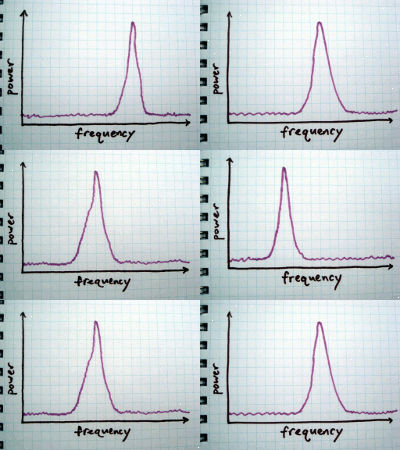
They propose looking at the emissions over shorter windows of time. A quick snapshot would show a signal that is actually narrowband, similar to the frequency spike produced by a traditional clock. Subsequent snapshots show that the signal is still narrow but shifted to different frequencies. (Click the graph for sophisticated and professional-looking animation.)

To some extent, the authors are correct, but they conveniently leave out a rather important detail. If you look at the signal the way the FCC requires, you see a wideband emission consisting of power at various frequencies under the regulatory limit.

If, however, you look at the signal the way the authors propose, you see a narrowband emission that exceeds the regulatory limit. You can't have it both ways, guys. You either show that the signal is wide, averaged over a range of frequencies, or you reveal that the radiated power exceeds the legal limit and that your spread spectrum clock is exploiting a loophole in the peculiarities of the FCC test specification.
Amazingly enough, this unscientific trash seems to be pretty much the last word on the subject. I think it is time for fresh eyes to look at spread spectrum clock generation. I've been looking at it for a little while and have developed two hypotheses.
Hypothesis #1: The increasing prevalence of spread spectrum clock generation is detrimental to the operation of a wide variety of radio systems. SSCG is becoming popular not just in PCs but in smartphones, LCD panels, and other high speed electronic devices. It is required by interface standards such as SATA and SuperSpeed USB. As more and more of these devices are deployed (probably billions per year), the noise floor is raised for everyone trying to use the radio spectrum. This hypothesis is hard to test, so I'm skipping it.

Hypothesis #2: Devices with spread spectrum clock generation are more susceptible to eavesdropping than those without. I'm talking about emission security, the problem that electronic devices tend to unintentionally emit radio signals that can reveal otherwise secret information. Someone might be able to discover the password for your bank account, for example, by monitoring radio signals produced by your computer.
There are two reasons I think SSCG results in an increased susceptibility to eavesdropping. The first is that SSCG devices produce stronger emissions. This is almost by definition: the reason SSCG is deployed in the first place is to get away with emissions stronger than those that would be permitted from a device without SSCG. The second is that SSCG emissions feature spread spectrum signatures that make it easier for an eavesdropper to pick the signals out of the noise. This will be a little more difficult to demonstrate, but techniques from the field of digital radio communication could be applied to the problem.
In the coming months I will attempt to test hypothesis #2. I'll start by analyzing the waveforms produced by popular spread spectrum clock generator integrated circuits, and then I will apply the knowledge gained to the problem of eavesdropping on consumer electronic devices. If you are interested in helping with this research, I would love to hear from you!
Wednesday, June 15, 2011
If it isn't open, it didn't happen.
A few weeks ago I watched The Architecture of Access to Scientific Knowledge, a thought-provoking lecture given by Lawrence Lessig at CERN in April. In it, Lessig argues that the application of copyright by publishers in the scientific community is harmful to science itself. If you have any interest at all in the progress of human knowledge, you should watch it.
The talk reminded me of Shaking Down Science, a blog post by Matt Blaze some months back. Blaze pointed out the very specific wrongs committed by two major publishers in the computer science field, the ACM and the IEEE. Demonstrating the very kind of leadership encouraged weeks later by Lessig, he announced that he would stop participating in these two organizations as a response to their policies that prevent open access to scientific knowledge.
I applaud this decision, but I don't think it goes far enough. I propose a specific boycott that anyone who publishes scientific research or who writes or talks about research can participate in: a citation boycott. If a paper is "published" only in a manner that prohibits open access by the public, it shouldn't be considered to have been published at all, and it shouldn't be cited in other works. If it isn't open, it didn't happen.
Easy for me to say, I know. I'm not in the habit of publishing scientific papers of my own; I just present the occasional result at a hacker con. Academic rigor demands that certain prior work central to the subject of a new paper be cited appropriately, of course, but I read enough scientific literature to know that plenty of citations are little more than filler. It should be possible to leave out a large percentage of non-open references from most bibliographies without undermining academic integrity.
We are in an age of democratization of science, when people like me, outside of the academic community, are able to participate in the advance of knowledge to an unprecedented degree. When those of us without access to scientific literature contribute, we often participate in this boycott without meaning to. We simply don't know that the prior work exists or can't afford to pay to read it. Maybe this citation boycott will gain some supporters in academia; maybe it won't. Either way, I believe that amateur scientists are central to the future of science and that researchers today who don't insist on open access for their own works will soon be forgotten.
Perhaps a strict boycott isn't possible in the academic world, but the trend is growing regardless. Even in fields far flung from science, reusable, reproducible works are gradually supplanting those that are more restricted. Maybe instead of calling it a boycott I should call it a bias, an attitude, a mantra: If it isn't open, it didn't happen.
Subscribe to:
Posts (Atom)